Flirting With French by William Alexander
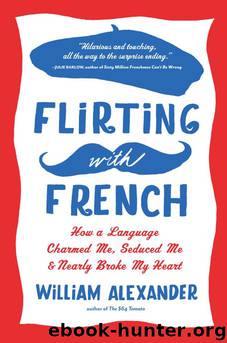
Author:William Alexander [Alexander, William]
Language: eng
Format: epub
ISBN: 9781616200206
Amazon: 1616200200
Publisher: Algonquin Books
Published: 2014-09-15T16:00:00+00:00
Et Tu, Brute?
The tu is generally used to insult a fellow automobilist and always used when talking to oneself or to death.
—International Herald Tribune, February 19, 2000
“Yes, Bill, you can tutoyer.”
Woo-hoo! My twenty-something glam-rocker part-time-model French pen pal, Sylvie, has given me the green light to use the familiar tu form with her. I feel très français.
Following protocol, or my understanding of protocol, I had first formally asked permission to use the familiar tu, and trust me, I agonized over the timing of this a good deal, because, well, a negative answer (“I think it’s a little premature for that, Bill”) would’ve been nothing short of humiliating. So I exhaled in relief when I received her reply, although something a little more positive, say, “Of course!” or “By all means—I thought you’d never ask!” would’ve been preferable to an answer that could just as easily be read as “[Sigh] If you must.”
Even most non-Francophones know that the French use two pronouns for addressing a second person. That is, there are two ways to say “you”: the formal (or polite) vous and the familiar tu. When to use which can be baffling to a foreigner, although to be fair to the French, they didn’t make this business up. Blame the Latin that Julius Caesar brought to Gaul and that formed the basis of modern French. Thus it should come as no surprise that variations of tu and vous are also found in the other Romance languages, such as Italian, Spanish, and Romanian. Now, I don’t know how it’s handled in, say, Romania, or even other francophone countries, but in France the usage of vous and tu is less about grammar than about social position and how one views oneself and one’s place in the world.
When I say that Caesar brought the formal vous to France, that’s not strictly true. In the Latin of Caesar’s day, everyone from your emperor to your dog was just tu. The Latin vos was strictly reserved for the plural (“you all”). The use of vos (which would become the French vous) to refer to a single person didn’t appear until the fourth century, and came about almost by accident. Its first use was to refer only to the dual Roman emperors, both of them, because by then the empire had split into an eastern empire ruled from Constantinople and a western empire overseen from Rome. Politically, however, the two emperors ruled with one joint voice, and to hammer home the point they began to refer to themselves as nos, or “we.” (This may be the origin of the royal “we” that today one tends to associate with English queens.)
Once the inevitable confusion that must have resulted was cleared up—I have this image of the western emperor sitting alone on his throne telling a puzzled page, “We’d like some coffee,” and the page returning with two cups and being called an idiot—the emperors’ people had to deal with a touchy issue of protocol: how to address someone who refers to himself as “we.
Download
This site does not store any files on its server. We only index and link to content provided by other sites. Please contact the content providers to delete copyright contents if any and email us, we'll remove relevant links or contents immediately.
| Anthropology | Archaeology |
| Philosophy | Politics & Government |
| Social Sciences | Sociology |
| Women's Studies |
Cecilia; Or, Memoirs of an Heiress — Volume 1 by Fanny Burney(32527)
Cecilia; Or, Memoirs of an Heiress — Volume 2 by Fanny Burney(31928)
Cecilia; Or, Memoirs of an Heiress — Volume 3 by Fanny Burney(31916)
The Great Music City by Andrea Baker(31899)
We're Going to Need More Wine by Gabrielle Union(19020)
All the Missing Girls by Megan Miranda(15889)
Pimp by Iceberg Slim(14464)
Bombshells: Glamour Girls of a Lifetime by Sullivan Steve(14038)
For the Love of Europe by Rick Steves(13818)
Talking to Strangers by Malcolm Gladwell(13331)
Norse Mythology by Gaiman Neil(13317)
Fifty Shades Freed by E L James(13216)
Mindhunter: Inside the FBI's Elite Serial Crime Unit by John E. Douglas & Mark Olshaker(9297)
Crazy Rich Asians by Kevin Kwan(9261)
The Lost Art of Listening by Michael P. Nichols(7476)
Enlightenment Now: The Case for Reason, Science, Humanism, and Progress by Steven Pinker(7288)
The Four Agreements by Don Miguel Ruiz(6728)
Bad Blood by John Carreyrou(6600)
Weapons of Math Destruction by Cathy O'Neil(6248)
